The investment case
The market sees the largest videogame launch in history. We think it is the installation event for a persistent entertainment platform, and the product that will determine most of Take-Two's value has not been shown yet.
The product
Leonida is far more than a backdrop for one story. It is an inhabitable simulation that can host an expanding catalogue of entertainment: further Rockstar stories, games, creator productions, music, live performance and sport. One population carries the same identity, friendships, property and history across all of it. The question that brings people back changes from what is left to finish? to what is happening tonight?
The evidence is cumulative. Rockstar has reportedly planned to expand GTA VI with new missions and cities over time. It acquired Cfx.re, the team behind FiveM, has invested in creator tools and commerce, and describes the engine, tools and team built for GTA VI as a foundation it does not intend to tear down again.
The catalyst
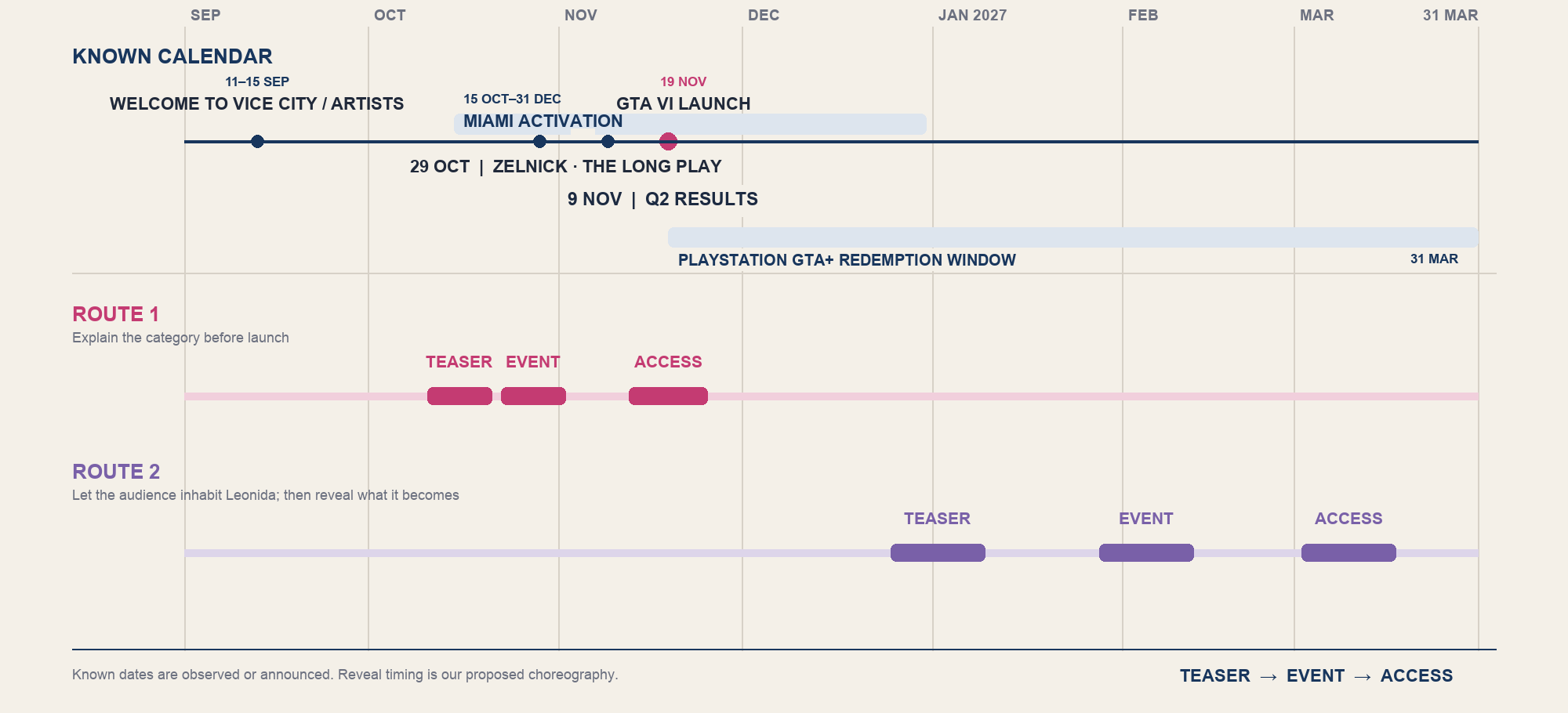
GTA VI launches on 19 November as a single-player production. The product that follows it has no public name, date, access model or description. If it has the architecture we describe, a run of feature announcements cannot explain it. We expect Leonida to get its own product moment in early 2027, when Rockstar names the continuing product and shows how its parts fit together.
The mature economics
Our platform case reaches around 113 million average monthly residents in 2030. It spans entertainment, membership, identity and virtual property, and the cost base does not rise in proportion to the catalogue.
- Average monthly residents, 2030
- 113m
- Recurring net bookings
- $19.4bn
- Operating profit
- $14.6bn
- Mature operating margin
- ~75%
A Bank of America high case, as reconstructed from public summaries, models roughly $2.2 billion of GTA Online net bookings in FY28. That is an aggressive forecast, but it is still a forecast for a bigger GTA Online. The debate comes down to what Rockstar builds on top of a record launch:
| Outcome | What Rockstar builds | Value per share |
|---|---|---|
| Conventional successor | A highly successful continuation of GTA Online | $199 |
| Narrow platform | Persistent architecture with slower adoption of entertainment | $746 |
| Entertainment platform | Broad catalogue, large monthly habit, mature economy | $1,422 |
Reference price $203.69 (23 October 2026 close). Valuation: 25× recurring Rockstar operating profit at the end of 2030, discounted to today, plus interim cash and the rest of Take-Two, less net debt.
What would prove us wrong
Every piece of evidence has a conventional explanation. If Rockstar presents a larger GTA Online built around missions, competitive play, periodic updates and virtual goods, we have mistaken product improvement for category creation. The product thesis can also be right while the timing is wrong, and even a real platform can fall short on audience, spending or cost.
How we will judge the reveal
Spectacle doesn't count. Famous artists, beautiful venues or the word platform confirm nothing by themselves. What we're testing is whether Rockstar discloses one continuing product: a named persistent world, broad access, identity and property that carry between productions, a catalogue beyond missions, outside production, GTA+ as membership, and a first-year slate with a date.
- Confirmed An integrated continuing product with persistent identity, broad access, an expanding catalogue, outside production and an economy.
- Partial A persistent world and creator tools, but a narrower catalogue, restricted access or a limited economy.
- Rejected A conventional successor: lobbies, missions, periodic updates and terminal virtual goods.
- Deferred Launch features only, with a broader roadmap explicitly kept open. The catalyst moves out.